Have you ever stopped to consider what it takes to engineer the product package sitting on the shelf, in the fridge, or in the freezer? Hormel Foods packaging scientists are constantly solving challenges to improve product quality, manufacturing efficiency, customer requests and material optimization.
Packaging improvement projects stem from customer requests, manufacturing challenges, or operational needs. As teams develop solutions, sustainability remains an important consideration, leading to improvements that reduce packaging materials, minimize waste, and support Hormel Foods’ broader Good Feeds Us All goals.
Start with a Challenge
For packaging scientists, innovation often starts with solving a practical problem, with prospects emerging from many directions. A retailer may request a new packaging format that later proves valuable for other customers, while a facility or process change can create an opportunity to rethink existing materials or approaches. As packaging scientists evaluate these opportunities, their focus is on developing solutions that maintain product quality, protect products throughout distribution, and support the needs of customers, operations teams, and retail partners.
For Chad Donicht, director R&D packaging at Hormel Foods, this is often a collaborative effort that sometimes starts on the manufacturing floor. “A lot of times when we’re on the plant floor with the operators or the maintenance team or the plant professionals, they’ll call out, ‘Hey, we’ve been struggling with this aspect of the package,’” he says. “or ‘This doesn’t look right,’ or ‘Why do we do this?’”
While these projects are designed to solve specific business challenges, the resulting improvements can often extend beyond the original objective, creating material reductions, an increase in operational efficiencies and progress toward broader sustainability goals. In many cases, some of the most impactful improvements happen behind the scenes. Shipping materials, inner packaging components, how the package is transported, and store-friendly packaging are designed to be as efficient as possible. Because these materials and processes are used on such a large scale, even a small modification could make a meaningful impact.
As Donicht explains, the success of these projects isn’t measured by a single outcome. “The wins are (seen in) efficiency, cost savings and material reductions. It could have an ergonomic impact. It could be shipping efficiencies to help transportation. It could be mitigating customer frustration.”
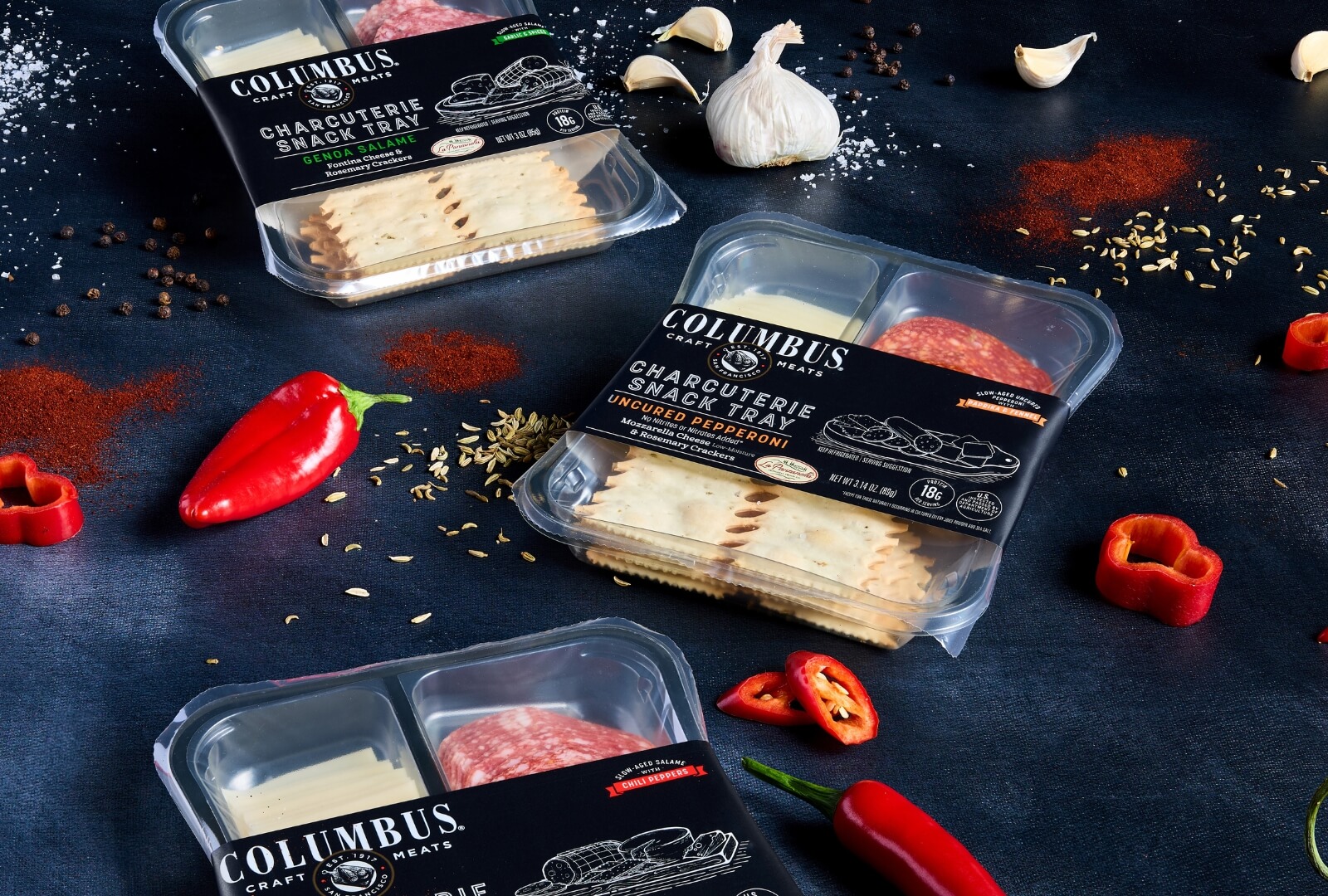
One example of this approach can be found in the redesign of the COLUMBUS® Charcuterie Snack Trays, which illustrates how a simple customer request can benefit multiple objectives.
Testing it Out
When a major retailer expressed interest in carrying COLUMBUS® Charcuterie Snack Trays but required the package to fit within a shelf display system, the packaging team faced a unique challenge. The team needed to create shorter packaging to fit on their shelf displays. At the same time, the team needed to maintain the same product weight, avoid disrupting existing foodservice customers, and ensure the package could continue running efficiently through production.
Before anything can move forward, it must also undergo rigorous testing to ensure it performs throughout the entire process: manufacturing, distribution, and reaching store shelves.
“It’s not as simple as making the tray shorter,” says Ashley King, senior packaging scientist at Hormel Foods. “We reduced the tray length by more than an inch without changing the amount of product inside, so we had to rethink how all three components fit together within the smaller footprint.”
The team got to work redesigning the layout, which meant rearranging components and adjusting the positioning of the meat, cheese, and crackers inside the package. The result was a new tray design that met the retailer’s requirements while preserving the product that already existed.
According to Donicht, what sounds like a simple packaging adjustment often requires extensive coordination. “The amount of work and detail that goes into a packaging change sounds simple”, he says. “Changing a box size, carton, or updating a film sounds easy, but the number of groups in Hormel (Foods) and steps along the way that are involved to ensure the integrity of the package would surprise people.”
With close collaboration across retail and foodservice teams, operations, marketing, suppliers, and manufacturing partners, the team was able to create a single design for the COLUMBUS® Charcuterie Snack Trays that could serve all customers – retail and foodservice combined. The new design removed the need to have two nearly identical products, which reduced complexity and helped streamline production. On top of juggling the design and two different business groups, the packaging team also had to work against a strict deadline to make sure that this new package could be on shelves for people to enjoy in a timely manner.
“There are many moving parts when coordinating production equipment and supplier timelines,” King says. “We stay closely aligned through regular communication and cross-functional collaboration to ensure projects remain on schedule.”
From a reduced packaging footprint to efficiencies in production, this collaboration produced more than just a packaging solution, and demonstrated benefits across the business.
Customer Need to Broader Impact
While the project began as an effort to meet a retailer’s shelving requirements, the redesigned tray also reduced the overall packaging footprint, demonstrating how practical packaging improvements can generate broader benefits. By meeting the retailer’s requirements, the team was able to begin offering this product in a retail store. At the same time, the smaller tray reduced the overall packaging footprint, supporting Hormel Foods’ broader efforts to reduce packaging materials as outlined in the Company’s Good Feeds Us All initiatives.
“This project is important because it helped us get new retailers on board,” King says. “We made a small adjustment to the tray while keeping the same product weight, which allowed us to meet the retailer’s needs without changing the consumer experience. When we’re able to bring on new customers, that’s a win for the business. We also reduced the overall tray footprint, which supports our ongoing sustainability efforts to minimize packaging materials wherever possible.”
When we’re able to bring on new customers, that’s a win for the business. We also reduced the overall tray footprint, which supports our ongoing sustainability efforts to minimize packaging materials wherever possible.”
Ashley King, senior packaging scientist, Hormel Foods
What begins as a customer request or operational challenge can lead to benefits that extend far beyond the original objective. By continually evaluating how products are packaged, transported, and displayed, teams across Hormel Foods are finding new ways to increase efficiency, support customers, and contribute to the company’s Good Feeds Us All guiding principles.
Hormel Foods has committed to reducing 10 million pounds of packaging materials by 2030. Based on this year’s Global Impact Report, Hormel Foods has currently reduced 6 million pounds of materials since their 2021 baseline, which marks a 61% achievement of their goal. In 2025, the company saved approximately 1.1 million pounds of packaging materials alone.
By the Numbers
At Hormel Foods, making a meaningful difference is anchored in the commitment to drive positive impact that strengthens communities and, nourishes people, and teams. Projects like these demonstrate how everyday business decisions can contribute to a broader impact. You can learn more about our Good Feeds Us All Initiative here.